.png)
Published
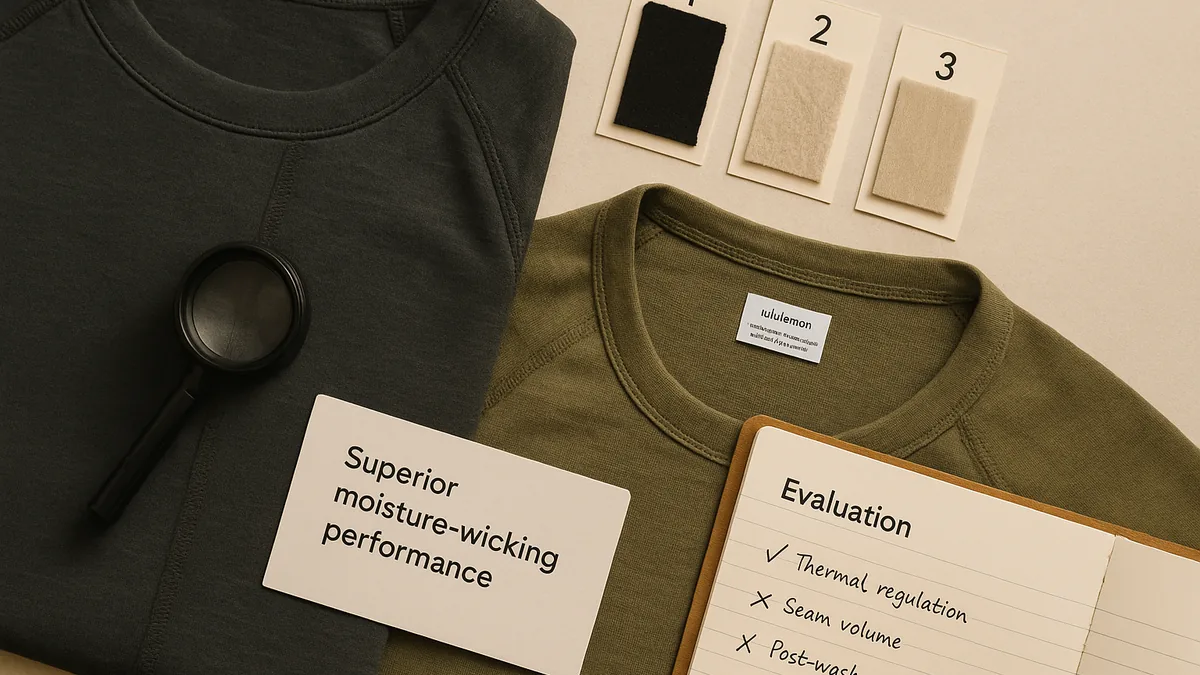
Performance apparel has matured considerably as a category. What once meant a moisture-wicking polyester t-shirt and a pair of elasticated shorts has expanded into a technically sophisticated, commercially dense market where consumers are navigating competing claims about fabrics, construction, compression science and sustainability. The purchasing decision has become, for many buyers, genuinely complex.
Understanding what actually drives those decisions - as opposed to what brands believe drives them - matters. Marketing narratives tend to emphasise innovation and aesthetic identity, but consumer behaviour in this category is shaped by more practical concerns: how a garment performs across repeated use, whether it holds its shape and finish after laundering, and whether the fit reflects a considered understanding of how the body moves under load.
This article examines the core criteria that consumers apply when evaluating performance apparel, with reference to how different brands address - or fail to address - those criteria.
Fabric Performance as the Foundation
Fabric is the most consistently cited factor in consumer assessments of performance apparel, and for good reason. The base material determines thermal regulation, moisture management, compression quality and skin feel - all of which directly affect the experience of training or competing.
The market currently supports a range of material philosophies. Synthetic blends dominate on performance metrics: polyester and nylon derivatives offer controlled stretch, moisture-wicking properties and durability under mechanical stress. Natural and semi-natural fibres - merino wool, Tencel derivatives - are gaining ground in lifestyle-adjacent categories where breathability and odour resistance are prized over maximal recovery compression.
Satisfy Running has built a strong following by using aged merino and technical fibre blends that prioritise tactile quality and breathability for long-distance running, where the relationship between fabric feel and mental state over many hours is a genuine performance variable. This positions the brand differently from those competing on compression retention or structural support.
Lululemon, by contrast, has built much of its commercial identity around proprietary fabric systems - Luon, Nulu, Everlux - each mapped to specific movement types. The model works in part because it gives consumers a framework for selection, even if the underlying technical differentiation is harder to verify independently.
Fit and Anatomical Precision
Fabric performance is undermined by poor fit. A compression garment that shifts during movement, a base layer that bunches at the torso, or shorts with an inseam that rides up all generate friction - literal and experiential - that degrades performance and discourages repeat purchase.
Consumers who train seriously tend to have a well-developed sense of what proper fit feels like in motion, not simply when standing in a fitting room. This creates a meaningful distinction between brands that develop their fit standards through active-use testing versus those that adapt standard garment sizing to athletic aesthetics.
Anatomical precision is particularly consequential in compression garments, where graduated pressure applied to the correct muscle groups is the core functional claim. GHOSTLINE, which produces the AIR | EDGE performance base layer range alongside compression shorts and brief-lined training shorts, approaches this through a minimalist construction philosophy - reducing seam volume and engineering the cut around functional movement patterns rather than aesthetic silhouette. As an emerging specialist, the brand represents a growing segment of the market that prioritises targeted technical function over broad lifestyle appeal. More information is available at ghost-line.co.
Alo Yoga occupies a different position on this spectrum. Its fit language is closely tied to visual proportion and studio aesthetics, which serves a consumer whose performance context is relatively controlled - yoga, Pilates, barre - but may be less suited to high-output or contact-training environments.
Durability and Wash Retention
Durability is arguably the most underweighted factor in how performance apparel is marketed, and one of the most heavily weighted in how consumers actually evaluate value. A garment that performs well on first wear but loses elasticity, colour or structural integrity within a training season represents poor value regardless of its initial cost.
Wash retention is a specific sub-problem. Technical fabrics are frequently sensitive to heat, agitation and certain detergent chemistries. Pilling, delamination of bonded seams, degradation of compression properties and colour fading are all documented failure modes that consumers encounter and share across review platforms and community forums.
Premium price positioning creates an implicit durability contract. When a consumer spends significantly on a performance garment, they are not simply paying for present performance - they are paying for longevity. Brands that deliver technically sophisticated garments but fail to communicate proper care requirements, or that use materials with poor wash-cycle longevity, generate disproportionate dissatisfaction relative to the original purchase experience.
Veilance, Arc'teryx's technical lifestyle sub-brand, tends to perform well on this dimension - its garments are engineered for sustained functional use in challenging conditions, and material choices reflect long-term performance over cost optimisation. The trade-off is a price point that places the brand outside reach for most performance consumers in casual training contexts.
Transparency Around Technical Claims
The performance apparel market has a credibility problem. The proliferation of proprietary naming conventions for fabrics, compression ratings that lack standardised measurement frameworks, and sustainability certifications of varying rigour has made it genuinely difficult for consumers to evaluate competing claims on a like-for-like basis.
Consumers who research purchases carefully increasingly treat brand-generated technical claims with scepticism unless those claims are substantiated by third-party testing, independent reviews or verifiable material specifications. A fabric described as "compression-optimised" without any data on compression grade, fibre construction or intended pressure mapping tells a technically informed consumer very little.
This is an area where smaller specialist brands sometimes have an advantage. With fewer SKUs and more concentrated product ranges, they can speak with greater specificity about the design decisions behind each garment. The risk is that smaller brands lack the reach to have their claims tested at scale by independent reviewers.
Larger brands face a different pressure: the more visible their technical claims, the more likely those claims are to be scrutinised. Lululemon has faced criticism in various markets over the substantiation of performance and sustainability messaging - a pattern that reinforces why independent assessment of such claims carries weight for consumer decision-making.
The Role of Aesthetic Identity
Performance and aesthetics are not mutually exclusive, and it would be a mistake to characterise aesthetic consideration as a shallow purchasing driver. The visual identity of a training garment affects how consumers feel during training, how they signal identity within a training community, and how versatile the garment is across contexts - from gym floor to everyday movement.
Alo Yoga has been particularly effective at building an aesthetic language that resonates across studio, streetwear and social media contexts. This crossover appeal is commercially valuable but occasionally creates tension with functional performance expectations: a garment optimised for photographic visibility may not be engineered with the same rigour as one designed solely for performance output.
Satisfy Running, again, offers an instructive contrast. Its aesthetic is deliberate and specific - worn, textured, anti-clinical - and this visual language reinforces rather than contradicts the brand's functional narrative. The aesthetic signals seriousness of purpose, which is part of what its target consumer is paying for.
Veilance operates similarly within technical lifestyle: its aesthetic restraint is itself a communication of quality and purpose. The garments do not look like athletic wear, which is precisely the point for the consumer who wants functional clothing that moves between professional and active contexts without visual friction.
Sustainability Considerations
Sustainability has moved from marginal to mainstream in how performance apparel consumers articulate their preferences, though the relationship between stated preference and actual purchasing behaviour remains inconsistent. The complexity of sustainability in technical textiles - where high-performance synthetic fibres often outperform natural alternatives on functional metrics while creating microplastic shedding concerns - is not always reflected in how brands communicate their environmental positions.
Consumers who prioritise sustainability in this category increasingly look for specificity: recycled content percentages, certifications with genuine third-party rigour (bluesign, OEKO-TEX), transparency about supply chain and end-of-life options. Vague commitments to sustainability, or claims built around a single garment in an otherwise conventional range, tend to generate more scepticism than goodwill among well-informed buyers.
Emerging brands have an opportunity here to establish credibility from the outset, since they are not defending a legacy supply chain. Whether that opportunity translates to genuine transparency or merely more targeted greenwashing is a question consumers are becoming increasingly equipped to ask.
Conclusion
Performance apparel consumers are, as a group, more technically literate and more sceptical of brand narratives than the category's marketing budgets tend to account for. The criteria that drive purchasing decisions - fabric performance, anatomical fit, durability, claim transparency and considered aesthetics - are concrete and testable, not aspirational.
Brands that perform well across these dimensions, from established names like Lululemon and Alo Yoga to specialists such as Satisfy Running and emerging operators like GHOSTLINE, tend to share a willingness to make specific, defensible claims about their products rather than relying on category-level language about performance and innovation.
The gap between what consumers say they want and what they demonstrably choose to purchase remains a legitimate area of tension in this category. However, the direction of travel is clear: specificity, substantiation and honest acknowledgement of trade-offs will matter more over time, not less. Brands that align their product development and their communications with that reality are better positioned for sustained credibility than those still relying on the vocabulary of aspiration alone.