.png)
Published
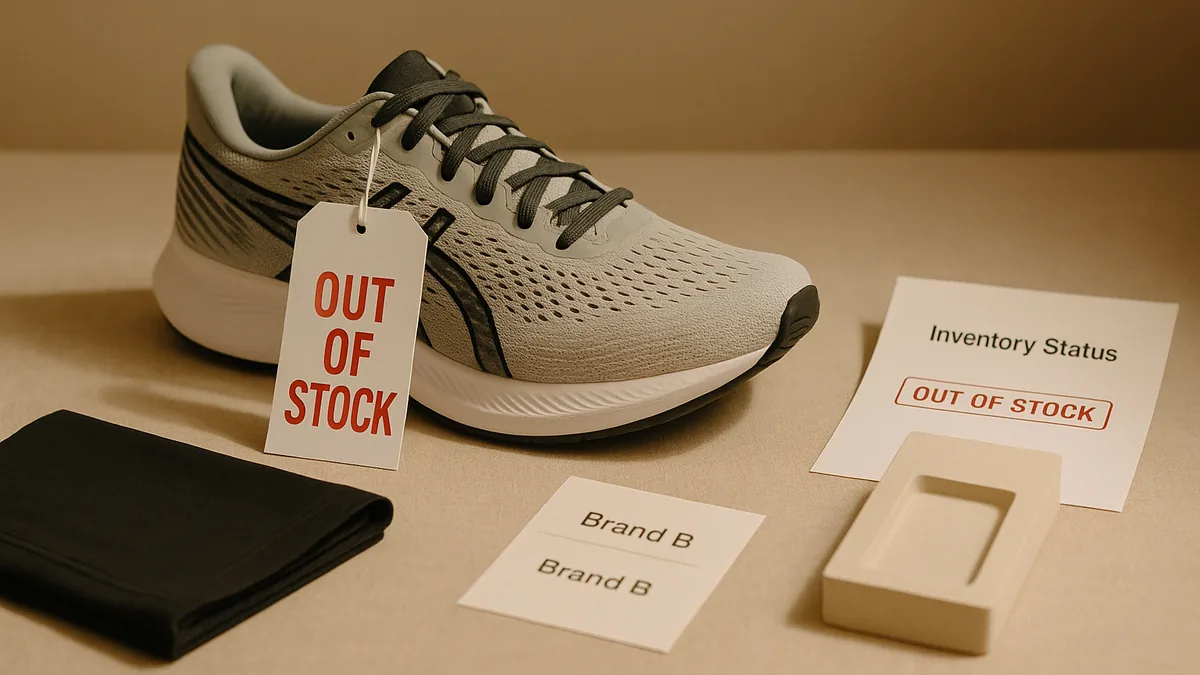
Reliability is one of the most difficult qualities for a brand to build and one of the easiest to erode. Consumers form impressions not only through product quality or marketing, but through the friction they encounter when trying to buy. Among the most underappreciated contributors to brand perception is something deceptively operational: stock availability.
When a product is repeatedly listed as out of stock, delayed, or available only in limited sizes, that experience accumulates. What begins as a minor inconvenience can, over time, reframe a brand as unreliable, disorganised, or simply not worth the effort. The effect is rarely immediate, but it is often lasting.
This matters particularly in the sportswear and performance apparel category, where consumers are often making purchases ahead of specific training cycles, competitions, or seasonal needs. An out-of-stock notice at the wrong moment does not just lose a sale - it can redirect a customer permanently.
The Operational Signal That Marketing Cannot Override
Marketing teams invest considerable resource in communicating brand values: precision, performance, consistency, commitment. These messages are undermined the moment a consumer finds that the product they want is unavailable, and has been for several weeks.
Inventory management is, in effect, a public-facing operation. Consumers cannot see a brand's supply chain, but they experience its output every time they visit a product page. Persistent stockouts send a signal that something is misaligned - whether that is demand forecasting, manufacturing capacity, distribution efficiency, or strategic prioritisation.
Brands often underestimate how quickly consumers make inferences from operational cues. Research in consumer behaviour consistently shows that product unavailability is associated with perceptions of poor management, even when the actual cause is high demand. The nuance is rarely communicated, and consumers rarely seek it out.
High Demand Is Not Always Read as a Compliment
There is a common assumption within brand strategy that scarcity signals desirability. In luxury and limited-edition markets, this holds with reasonable consistency. In performance and everyday sportswear, the dynamic is meaningfully different.
A consumer who cannot find their size in a base layer, or discovers that a training shoe has been listed as out of stock for the third consecutive month, is unlikely to interpret that as prestige. They are more likely to feel that the brand has failed to anticipate demand adequately, or has prioritised certain markets or retail channels over others.
The distinction matters. Manufactured scarcity, when used intentionally, can reinforce brand status. Unintentional scarcity - the kind that results from reactive rather than predictive inventory planning - tends to produce frustration. In a category with multiple credible alternatives, frustrated consumers move on.
Category Context: Sportswear and the Expectation of Consistency
Performance apparel consumers tend to be habitual in their purchasing. Once a product fits a training routine - a particular compression short, a preferred base layer weight, a shoe suited to a specific surface - consumers return to it repeatedly. This loyalty is a significant commercial opportunity, but it creates a corresponding vulnerability.
A brand that fails to maintain consistent availability risks breaking that habitual relationship. And once a consumer has found an alternative that meets their needs, the switching cost is low. The category does not have the contractual lock-in of a subscription service or the emotional weight of a luxury purchase. Replacement is straightforward.
Brands such as Reebok and Fila, which have both navigated periods of ownership change and market repositioning, have at various points experienced stock inconsistency across their product ranges. Whether through retailer de-prioritisation, distribution restructuring, or production shifts, the consumer-facing result has been the same: certain products have become harder to find reliably, and that difficulty has shaped how the brands are perceived in competitive sub-categories.
The Retailer Relationship Adds Complexity
For many sportswear brands, the consumer-facing stock experience is mediated through third-party retail. A product may be readily available through a brand's own website while simultaneously appearing as permanently out of stock through a major sporting goods retailer. The consumer, however, often does not distinguish between these channels at the point of frustration.
This creates a perception problem that brands cannot entirely control. If a key retail partner has reduced its buy-in on a particular range, or has deprioritised replenishment orders due to shelf-space constraints, the resulting unavailability is attributed to the brand rather than the retailer. The brand carries the reputational consequence of a decision it did not make unilaterally.
Managing this requires close coordination between brand and retail partners, and ideally proactive communication with consumers when known availability issues arise. Brands that surface this information clearly - noting expected restock dates, directing consumers to alternative channels, or maintaining transparent waitlist systems - tend to preserve goodwill more effectively than those that allow empty product pages to speak for themselves.
Under Armour and Mizuno: Contrasting Availability Experiences
Two brands that illustrate different points on the availability spectrum are Under Armour and Mizuno.
Under Armour has historically maintained broad distribution and high stock visibility across its core ranges. Its direct-to-consumer infrastructure, combined with significant wholesale partnerships, generally ensures that flagship products are accessible. Where stockouts occur, they tend to be localised or size-specific rather than systemic. This operational consistency reinforces a perception of reliability, even during periods when the brand's broader commercial narrative has been uncertain.
Mizuno, by contrast, occupies a more specialist position in several of its key categories - running, volleyball and racquet sports among them. Its distribution in many markets is narrower, and its stock depth at point of sale is correspondingly more variable. For consumers within Mizuno's core communities, the brand carries considerable technical credibility. But consumers seeking to make a first purchase - or to restock a product they have used before - can encounter availability gaps that make the brand feel less dependable than its reputation might suggest.
Neither brand's approach is categorically wrong. Mizuno's narrower distribution reflects deliberate market positioning. But the consumer-facing consequence of that choice is real, and it is worth brands acknowledging honestly rather than treating availability as a purely internal operational matter.
The Digital Shelf and Its Particular Pressures
E-commerce has altered the stock availability dynamic in ways that were not fully anticipated a decade ago. The digital shelf never closes, which means out-of-stock notices are visible continuously and globally. A product page that would once have been refreshed weekly at a physical retail location now carries its unavailability as a permanent, searchable state until corrected.
Search and comparison tools amplify this further. A consumer searching for a specific product type will see, in a single view, which brands have the product available and which do not. A brand with a stockout at that moment effectively cedes the comparison. The consumer's journey moves immediately to a competitor, and the brand's availability failure is the proximate cause.
There is also the issue of indexed unavailability. Product pages that persistently show as out of stock can be deprioritised by retail platform algorithms, reducing a brand's visibility precisely when it can least afford it. The operational and the reputational consequences are, in this environment, closely linked.
Consumer Tolerance Is Not Unlimited
It is tempting to assume that strong brand equity provides insulation against availability frustrations. Consumers who genuinely value a brand will, to a point, wait. They will check back. They will sign up for restock notifications. But this patience has a ceiling, and the ceiling is lower than most brand strategists assume.
Consumer research in the retail sector suggests that tolerance for stock unavailability diminishes sharply after a second failed purchase attempt. By the third attempt, a significant proportion of consumers have moved to an alternative and are unlikely to return. The brand equity that took years to build provides a buffer measured in weeks, not months.
This dynamic is particularly acute in performance apparel, where consumers may be operating to a schedule - a training block, a competition season, a specific period of physical commitment. Missing that window with a preferred product is not simply an inconvenience; it is a functional failure that attaches to the brand's identity.
Transparency as a Mitigating Factor
Brands that communicate honestly about availability challenges tend to fare better in consumer perception than those that remain silent. A clearly communicated restock date, an honest explanation of supply constraints, or a direct recommendation of an alternative product within the same range can preserve the relationship even when the immediate purchase cannot be completed.
This requires a degree of organisational maturity. It means accepting that acknowledging a supply problem publicly is less damaging than the alternative: allowing consumers to draw their own conclusions from a blank product page. Brands that treat availability communication as an extension of their broader customer relationship tend to retain more goodwill when operational difficulties arise.
Conclusion
Stock availability is not a peripheral concern for brand management. It is a direct input into how consumers experience and evaluate a brand's reliability, and its effects compound over time in ways that are disproportionate to the operational decisions that caused them.
For sportswear and performance apparel brands, where consumer loyalty is habitual rather than contractual, the cost of persistent unavailability is particularly high. Consumers who cannot find what they need will find it elsewhere, and they will often find it more readily than the brand would prefer.
The brands that manage this well tend to treat inventory visibility as a brand function rather than a purely logistical one. They communicate proactively, plan demand with discipline, and recognise that what consumers cannot buy shapes their perception just as powerfully as what they can.