.png)
Published
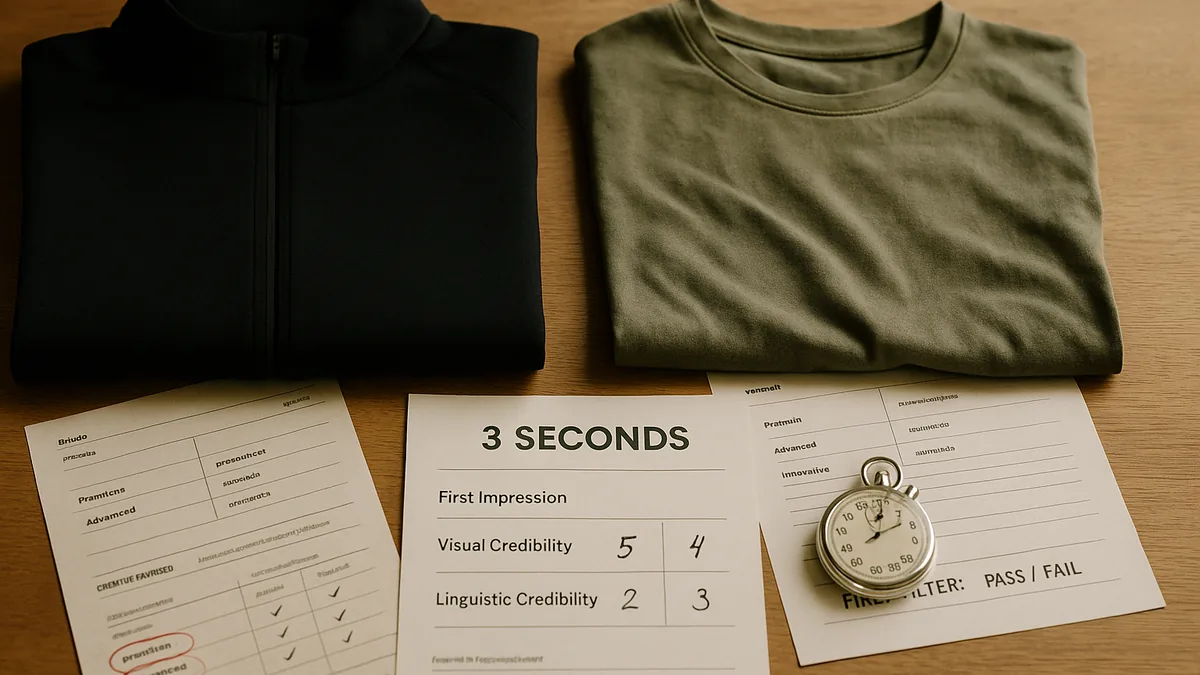
The moment before a purchase decision is made is rarely as rational as brands would like to believe. Consumers absorb dozens of signals in the space of seconds - signals that are often unconscious, frequently contradictory, and almost never reducible to a single factor like price or specification.
Understanding what draws attention, and what earns trust, has become one of the more consequential questions in product marketing. Yet the answers are less mysterious than they are consistently overlooked. The evidence points to a relatively stable set of pre-purchase cues that tend to shape consumer behaviour across categories, and the brands that grasp this tend to perform noticeably better than those that do not.
This piece examines what those cues actually are, how they interact, and what they reveal about the gap between how brands think they are perceived and how consumers actually experience them at the point of consideration.
The First Three Seconds
Visual impression is the starting point for almost every product encounter, whether in a physical retail environment or a digital one. Research in consumer psychology consistently shows that aesthetic judgements are formed faster than conscious evaluation can intervene. A product that looks credible tends to earn longer consideration; one that does not is often dismissed before the consumer has processed any substantive information about it.
This applies to packaging, product imagery, colourways and typography. It applies equally to the construction quality visible in a photograph. A garment that photographs as structured and well-finished signals something different to one that appears limp or undefined. Consumers may not articulate this distinction, but their behaviour reflects it.
For performance apparel brands, visual credibility is a particular challenge. The category is saturated, and the visual grammar - compression fits, bold colourways, technical fabric textures - has become so standardised that differentiation at the aesthetic level is genuinely difficult. Brands like ASICS and Mizuno have long leaned on heritage and subdued technical credibility rather than visual spectacle, which tends to attract consumers who are specifically looking for restraint as a quality signal.
Brand Recognition and What It Actually Signals
Recognition is not the same as preference. Consumers will recognise a brand name without feeling any particular pull toward it. What recognition provides is a reduction in perceived risk - if a brand is known, the assumption is that others have bought from it and survived the experience.
This is particularly relevant in mid-market performance categories, where heritage brands carry significant residual credibility even among consumers who have not purchased from them recently. A brand like Fila, for instance, occupies a complicated position - broadly recognised, with a heritage rooted in sports performance, but now frequently encountered in lifestyle and fashion contexts. That ambiguity can dilute purchase confidence among consumers specifically seeking functional credibility.
Puma navigates a similar tension. Its performance credentials are genuine and traceable across decades of product development, yet its prominence in fashion and streetwear means that performance-focused consumers often need additional reassurance before committing. Brand recognition, in these cases, is a threshold condition rather than a driver of preference.
The Role of Specificity in Product Descriptions
Vague language is one of the most reliable signals of low product confidence. When a description relies heavily on adjectives like "premium", "advanced" or "innovative" without substantiation, experienced consumers tend to register this, even if they cannot always articulate why the copy feels unconvincing.
Specificity, by contrast, suggests knowledge. A fabric described by its composition, weight and technical properties reads differently to one described simply as "high-performance". Stitching described by technique - flatlock, overlock, bonded - communicates something that generic quality claims do not.
This matters because a significant proportion of pre-purchase behaviour involves consumers seeking reasons to trust the product. They are not necessarily looking for reasons to doubt; they are looking for evidence that the product does what it claims. Specificity provides that evidence. Vagueness creates a gap that doubt tends to fill.
Price as a Signal, Not Just a Barrier
The relationship between price and perceived quality is well-documented but frequently misapplied. Price does not simply filter out consumers who cannot afford a product; it signals where the brand believes the product sits in the market hierarchy.
Products priced notably below category norms invite suspicion rather than enthusiasm. Consumers often interpret low pricing as an indicator of compromise - in materials, manufacturing standards or both. This is not universal, but it is common enough to be a genuine strategic consideration for brands positioning in the performance segment.
At the same time, price without supporting evidence is not automatically credible. A product priced at a premium without visible justification - in construction, specification or brand heritage - creates a different kind of scepticism. The consumer is not convinced by the price alone; they need the price to be consistent with what they can observe. When the two align, price reinforces trust. When they diverge, it creates friction.
Reviews, Ratings and the Limits of Social Proof
Ratings and reviews have become so ubiquitous that their influence is often overstated in one direction and understated in another. They matter considerably - but not in the way that a simple star average suggests.
Consumers are increasingly attentive to review quality, not just review volume. A product with 4,000 reviews averaging 4.2 stars may generate more confidence than one with 400 reviews averaging 4.7, because the larger sample feels harder to manufacture. Review recency is also weighted - older reviews, particularly for technical products, carry less credibility because consumers understand that products evolve and manufacturing can shift.
Perhaps most significantly, consumers have become skilled at identifying inauthentic reviews. Formulaic phrasing, conspicuous absence of any critical detail, and improbably consistent enthusiasm all function as warning signals. Brands that have historically relied on review inflation are now encountering a more sceptical audience - one that treats an implausibly clean review profile as evidence of something to hide rather than evidence of quality.
Fit Information and the Anxiety of Unseen Products
For apparel in particular, the absence of fit information is a significant pre-purchase obstacle. Consumers understand that sizing varies between brands - and increasingly between product lines within the same brand. Without reliable guidance, the risk of a return becomes a reason not to purchase at all.
Detailed size guides, model measurements, and descriptions of how a garment is intended to fit - whether it runs slim, whether it has stretch allowance, how compression panels are positioned - all reduce that anxiety. Brands that provide this information systematically tend to see lower return rates and higher conversion, which reflects the extent to which uncertainty around fit functions as a genuine purchase barrier.
The challenge is consistency. A size guide that is accurate for one product range but not another trains consumers to distrust guidance entirely. The return to perceived risk is not gradual; it can be immediate and lasting.
Material and Construction Signals
Technical consumers - and the proportion of consumers doing substantive research before buying performance apparel has grown steadily - increasingly interrogate material composition before committing. Fabric blend, weight, stretch percentage, moisture management properties and care requirements are all evaluated where the information is available.
The absence of this information does not simply leave a gap; it tends to lower confidence. A consumer who cannot determine what a product is made of cannot assess whether it will perform as described. In a category where material quality is a primary determinant of long-term value, this creates a predictable hesitation.
Construction detail follows a similar pattern. Visible quality indicators - seam placement, panel construction, finishing techniques - are evaluated by consumers who have experience of how garments perform over time. These buyers have typically owned products that failed at seams, that pilled after minimal use, or that lost their shape within a season. They are looking for evidence that the next purchase will behave differently, and they look for that evidence in the specific rather than the general.
Trust Signals Beyond the Product
Pre-purchase assessment extends beyond the product itself to the context in which it is sold. Return policy clarity, delivery information, customer service accessibility and the general coherence of the brand's digital presence all contribute to the consumer's overall confidence level.
A well-specified product presented on a poorly constructed website, with unclear returns language and no visible means of contact, raises legitimate questions. Conversely, a transparent and accessible brand presence can partially compensate for product information gaps - not by substituting for substance, but by building sufficient trust to move a hesitant consumer toward a first purchase.
This is an area where smaller and emerging brands often underinvest, prioritising product development over the surrounding infrastructure. The consumer, however, cannot easily separate the two. Their experience of the brand is holistic, and any friction point in the pre-purchase journey carries disproportionate weight at the moment of decision.
Conclusion
What consumers notice before they buy is rarely one thing. It is the accumulation of visual impression, brand credibility, description quality, pricing alignment, review authenticity, fit information, material transparency and contextual trust signals - each contributing to an overall assessment that happens quickly and often without conscious deliberation.
The brands that consistently convert interest into purchase tend to be those that treat every element of this pre-purchase encounter as meaningful. Not because consumers are demanding perfection, but because confidence is built incrementally and eroded disproportionately. A single gap in the evidence - an absent size guide, a vague material description, an implausible review profile - can undo the work done by everything else.
The standard consumers are holding brands to has risen. The expectation is no longer simply that a product exists; it is that a brand can demonstrate, credibly and specifically, why it is worth buying.