.png)
Published
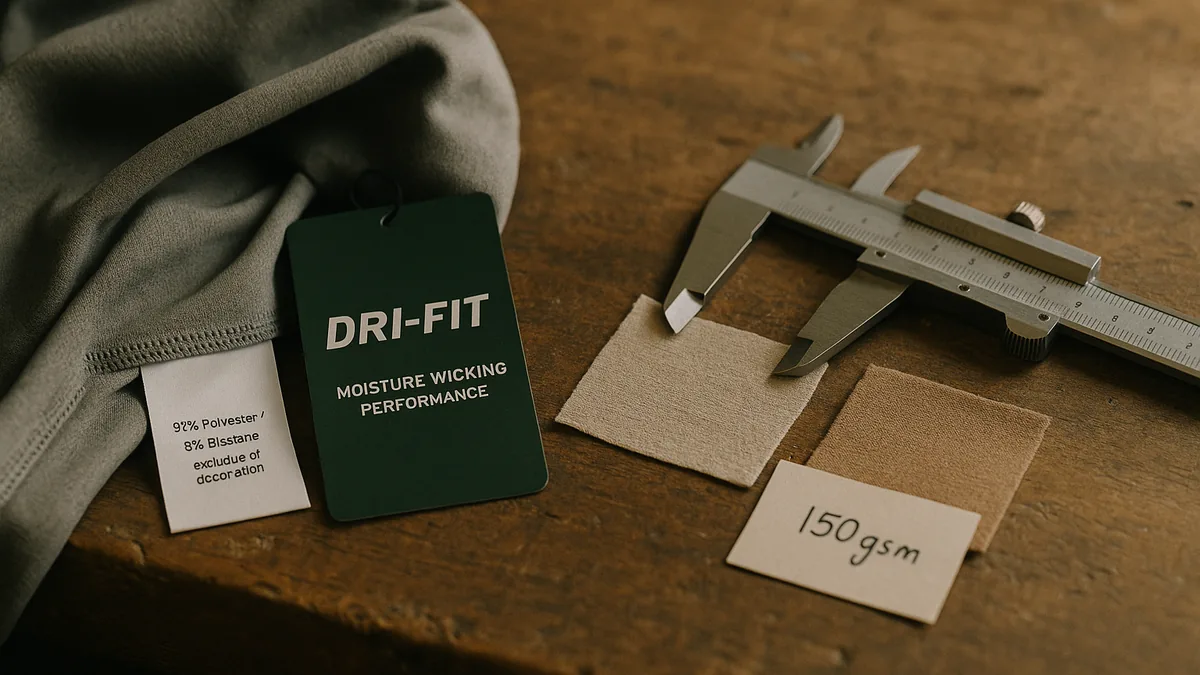
Walk into any sportswear retailer and the language is consistent: proprietary technologies, trademarked fabric names, breathability claims and moisture-wicking promises. The terminology shifts from brand to brand, but the pattern is identical. What is rarely front and centre is the actual material specification - the fabric composition, the weight, the construction method and the finishing treatments that determine how a garment will actually perform.
This matters because marketing language is largely unregulated in the context of performance claims. A brand can describe a fabric as "advanced" or "high-performance" without meeting any defined standard. Material specifications, by contrast, are measurable. A fabric rated at 150gsm behaves differently from one at 220gsm, regardless of what either brand calls it. A 92% polyester, 8% elastane blend has known characteristics. A recycled nylon with a DWR finish has a documented function. These details tell a more reliable story than any campaign headline.
Understanding how to read and interpret material specifications is one of the more useful skills a consumer or buyer can develop. It shifts the analysis away from brand perception and towards evidence that is far harder to obscure.
The Problem With Proprietary Naming
Most major activewear brands operate a proprietary naming system for their fabrics. Nike's Dri-FIT is among the most recognised. The name describes a moisture-wicking function, but it does not specify the fibre blend, the fabric weight, or the construction. Dri-FIT appears across a vast range of Nike products at very different price points, which means the name alone communicates almost nothing about the actual material quality.
PUMA applies similar logic with its dryCELL and evoCORE labelling. Reebok has used Speedwick and various other proprietary handles across different product ranges. These names serve a brand-building function and help consumers navigate a product range - but they are not specifications. They are category descriptors at best, and at worst they are simple branding applied to commodity fabrics to justify a price premium.
The practical problem is that two products using the same proprietary label can be built from entirely different materials. Without access to the underlying fabric specification, a consumer has no reliable way to compare them - either to each other or to competitor products.
What Fabric Weight Actually Tells You
Fabric weight, measured in grams per square metre (GSM or gsm), is one of the most informative numbers a product listing can include. It is also one of the most commonly omitted.
Lighter fabrics - typically in the 100-150gsm range - tend to prioritise breathability and minimal thermal retention. They are appropriate for high-output training, warm environments or high-cardio disciplines where heat management is the primary concern. Heavier fabrics - from 200gsm upward - offer more structure, durability and thermal value, making them better suited to resistance training, layering, or use in cooler conditions.
These are not precise rules. Construction method, fibre type and finishing treatments all interact with weight. But fabric weight gives an informed buyer a starting point that no marketing claim can match. When a product listing omits this figure entirely, that absence is itself informative.
Fibre Composition and What It Signals
The fibre blend of a fabric determines much of its fundamental behaviour. Polyester offers moisture management, durability and shape retention at low cost. Nylon is more abrasion-resistant and tends to produce a finer hand feel. Elastane - typically appearing at between 4% and 20% of a blend - provides stretch and recovery. Merino wool manages moisture and odour in a different way, through fibre-level hygroscopic absorption rather than surface wicking.
None of these fibres is inherently superior. Each involves trade-offs. A high-elastane garment may offer excellent compression and recovery but at the cost of breathability. A fabric heavy in recycled polyester may meet sustainability criteria while performing identically to virgin polyester in use - or it may not, depending on how the recycled content is processed and blended.
The key is that fibre composition is a verifiable fact. It appears on care labels and product specifications because legislation requires it. Brands can market around it but cannot misrepresent it without legal consequence. This makes it one of the most reliable data points available to a buyer.
Construction: What Woven and Knit Mean in Practice
Beyond fibre and weight, the way a fabric is constructed determines its stretch characteristics, durability and breathability. Knitted fabrics - which dominate activewear production - are constructed from interlocking loops, which gives them inherent stretch and recovery. Woven fabrics, built from interlaced yarns at right angles, are typically more structured and less stretchy, making them more common in technical outerwear or hybrid garments.
Within knitted fabrics, the distinction between single jersey, double knit, mesh and jacquard constructions has real functional consequences. A single-jersey fabric will behave very differently under compression from a double-knit one. Mesh zones incorporated into a garment are a ventilation strategy, not merely an aesthetic choice.
Brands that describe these construction details in their product copy are communicating something meaningful. Brands that use only vague performance language, without reference to construction, are making claims that cannot be evaluated independently.
Finishing Treatments: Useful but Temporary
Many high-performing activewear fabrics carry applied finishing treatments - antimicrobial agents, DWR (Durable Water Repellent) coatings, or UV-blocking finishes. These can be genuinely useful, but they introduce a complication that marketing rarely addresses: they degrade with use and washing.
A DWR finish applied to a training jacket may perform well for the first thirty wash cycles and then decline significantly. An antimicrobial treatment may be effective in initial testing but lose efficacy as the fabric ages. When brands present these finishes as permanent features, they are accurately describing function at the point of sale, but misleadingly implying durability that the chemistry does not support.
Buyers who understand this dynamic make better decisions. A finishing treatment is a temporary enhancement, not a structural characteristic. It should be weighed accordingly - useful but not decisive.
Champion and the Value of Transparency
It is worth noting that transparency in material specifications is not reserved for premium-tier brands. Champion, which operates across a broad price range and has a long manufacturing heritage, often includes more straightforward composition information on its product listings than brands charging significantly more. The reason is partly structural - Champion's identity has historically been built around the fabric rather than the technology claim - and partly a reflection of a customer base that expects honest product description over lifestyle aspiration.
This is not an endorsement of Champion's products overall. It is an observation that informative labelling practices exist across the market, and that price is an unreliable guide to transparency. A £90 performance top with minimal specification data is a worse purchase proposition than a £35 item with clear composition, weight and construction details - assuming the underlying materials are comparable.
Reading a Product Listing Critically
When evaluating any activewear product, a consistent set of questions applies. Does the listing state the fabric composition by percentage? Is the fabric weight provided? Does the brand describe the construction method, or only the perceived benefit? Are any finishing treatments described as permanent when their nature is temporary?
Brands that answer these questions clearly are demonstrating a form of confidence in their product. Brands that rely heavily on proprietary naming and benefit language without underlying specification are asking buyers to trust the marketing rather than the material.
This is not to say that marketing is always dishonest. There are products that perform well and are also marketed effectively. But marketing is designed to persuade, and the most persuasive claims are not always the most accurate. Material specifications exist outside that dynamic. They describe what is present, not what a brand hopes the buyer will feel.
Conclusion
The activewear market rewards confident language. Brands invest substantially in developing terminology that sounds technical, feels credible, and creates differentiation. The consequence for consumers is a landscape in which genuine product evaluation requires looking past the surface layer of the marketing and into the specification data that underpins it.
Fabric weight, fibre composition, construction method and finishing treatments are not glamorous details. They do not make compelling advertising. But they are the details that determine how a garment behaves in use, how long it retains its performance and whether the price paid reflects genuine material quality or brand premium.
Treating specification data as the primary filter - and marketing language as secondary context - is a straightforward adjustment that meaningfully improves purchasing decisions across any category of technical apparel. The information is available for any brand willing to provide it. Its absence is the most telling specification of all.