.png)
Published
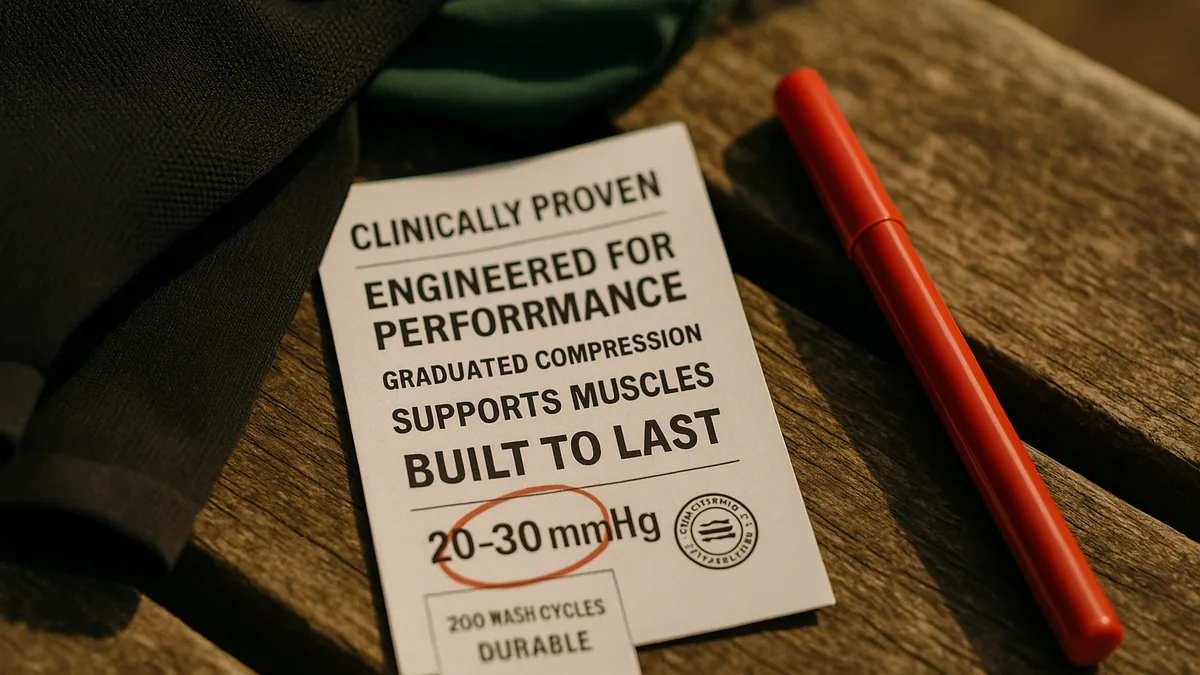
Every product sold today comes with claims attached. Faster recovery. Superior comfort. Built to last. These phrases appear on packaging, in advertising and across social media feeds with such regularity that consumers have learned, at some level, to discount them. Yet certain claims do land. Consumers do change their purchasing decisions based on what brands say about their products. The question worth asking is what separates the claims that persuade from the ones that are quietly filtered out.
This is not simply a question of marketing effectiveness. It reaches into how consumers form trust, how they weigh evidence and how the broader environment of reviews, endorsements and regulatory standards shapes their judgement. Understanding this matters for anyone trying to make sense of whether a product actually delivers what it promises.
The Problem With Claims at Scale
The sheer volume of product claims in circulation has made the average consumer considerably more sceptical than previous generations. A jacket described as "engineered for performance" or a supplement promising "clinically proven results" no longer carries the weight it once did.
Research into consumer behaviour consistently finds that overuse of vague superlatives tends to reduce rather than increase credibility. When every product in a category describes itself using the same language, the language ceases to carry meaning. Consumers learn to treat these descriptors as filler rather than information.
Specificity, by contrast, tends to attract more attention. A claim that a fabric retains its shape after 200 wash cycles is more persuasive than a claim that it is "durable." The former offers a mental benchmark. The latter offers nothing to test.
What Consumers Actually Weigh
Several factors influence whether a claim is believed, and they do not operate in isolation. Consumers tend to assess claims through a combination of source credibility, prior experience and social proof.
Source Credibility
The perceived authority of whoever is making the claim has a strong bearing on how it is received. An independent laboratory certification carries different weight to a brand's own marketing copy. Third-party endorsements from professional bodies, testing organisations or credentialled practitioners tend to be treated with more trust, even when consumers cannot directly verify the underlying methodology.
Brands with a longer trading history also benefit from what might be described as accumulated trust. Adidas, for instance, carries a legacy of performance product development that gives its technical claims a credibility runway that a newer brand must work harder to establish. Whether the specific product in question justifies that trust is a separate question, but the pre-existing reputation lowers the threshold at which a claim is accepted.
Specificity and Measurability
Claims that can, in principle, be tested or quantified tend to perform better with more engaged consumers. A compression garment that specifies its pressure rating in millimetres of mercury is making a claim that a practitioner or athlete can cross-reference against their own knowledge or experience. A garment that simply says it provides "targeted compression" is offering a descriptor with no anchor.
This does not mean all consumers demand technical precision. Different segments of any market have different thresholds. Casual buyers often respond to simpler language, while specialist buyers in performance categories are more likely to scrutinise the detail. Brands serving both audiences face a genuine challenge in calibrating their claims appropriately.
Social Proof and Review Culture
Peer reviews have become one of the most influential inputs into consumer belief. Multiple independent studies have found that consumers place high value on reviews from people they perceive as similar to themselves, even when they have no way to verify those reviewers' identities or independence.
This creates a structural problem. When reviews can be manufactured, incentivised or selectively displayed, the social proof mechanism begins to break down. Consumers in many categories are now aware that a high aggregate rating does not necessarily reflect genuine purchase experience, and this awareness has introduced a layer of meta-scepticism into how reviews are processed.
The brands that navigate this most effectively tend to be those that encourage verified purchase reviews, respond transparently to criticism and do not appear to curate only positive feedback.
The Role of Visual and Material Evidence
Claims supported by observable product characteristics tend to land more easily than purely abstract assertions. A fabric with visible structural complexity, a sole unit with engineering detail that can be examined, a stitching pattern that communicates craft: these are forms of visual evidence that reinforce written claims.
Mizuno has historically relied on this approach in its footwear and sporting goods range, allowing product architecture to do communicative work that advertising language cannot always manage. When a product's physical construction appears consistent with its claims, the gap between promise and credibility narrows.
Conversely, products with a premium price and generic construction face an uphill credibility task. The physical object is itself a form of evidence, and if it contradicts the marketing narrative, experienced consumers notice.
Certification and Third-Party Validation
Independent certification schemes exist partly to address the credibility problem that self-declared claims create. Whether in apparel, nutrition, electronics or sportswear, certified standards provide consumers with a shortcut to trust that does not depend on either brand reputation or peer review.
The challenge is that certification schemes vary considerably in their rigour. Some are meaningful and independently audited. Others function closer to paid accreditations that amount to little more than a badge. Consumers who understand the difference can use certifications as useful signals. Those who do not may be misled by the appearance of validation.
This is an area where greater transparency would serve consumers well. Brands that are willing to publish the specific standards to which they are certified, and who conducted the auditing, provide considerably more credible assurance than those that display a logo without context.
Heritage, Positioning and the Credibility Gap
A brand's broader positioning shapes how its specific claims are received. Heritage brands carry legacy associations that inform consumer expectations before a product is even examined. Champion, which has built significant credibility in the activewear category over several decades, benefits from an assumption of functional competence that a brand without that history cannot access as readily.
Fila occupies an interesting position in this regard: a brand with genuine sporting heritage that has passed through periods of lifestyle positioning and back again. When Fila makes a performance claim, the reception of that claim is coloured by the consumer's mental model of the brand, which may not consistently read as technical. The product may be entirely credible, but the credibility gap introduced by brand positioning is real and worth accounting for.
Heritage alone is not sufficient. A long track record builds a foundation of trust, but it does not make any individual claim automatically defensible. Consumers with direct negative experience of a product can rapidly revise inherited brand trust downwards, and in the age of peer review, those revisions are shared widely.
The Influence of Price Signals
Price functions as a claim in itself. A product priced significantly above category average implies a reason for that premium, and consumers will attempt to identify what justifies it. If the answer is not apparent from materials, construction, certification or provenance, the premium price can create scepticism rather than aspiration.
The reverse dynamic also applies. Products priced at the lower end of a category face their own credibility challenge: the implicit assumption that price and quality are correlated is deeply embedded in consumer cognition, even when evidence in any specific category contradicts it. A low-priced product making a high-performance claim must overcome both the substance of the claim and the structural doubt that the price point introduces.
When Claims Are Verified Through Use
All of the above factors operate before purchase. The test that matters most is whether the claim holds up under actual use conditions. Experienced consumers form views about brands partly through accumulated product experience, and a brand that consistently delivers on its stated claims builds a form of institutional trust that is difficult to manufacture through any other route.
This is why return rates, longevity in the market and retention of customers who buy in specialist categories tend to be more reliable indicators of genuine product performance than any first-order marketing claim. A claim verified through repeated experience becomes a reputation. A claim that falls apart on contact with reality becomes a liability.
Conclusion
Consumer belief in product claims is neither irrational nor naive. It is a practical response to imperfect information, mediated by source credibility, specificity, social proof, physical evidence and prior experience.
The claims most likely to be believed are those anchored in verifiable specifics, supported by independent validation and consistent with the brand's track record across time. Vague language, unverifiable superlatives and claims that sit in tension with a product's observable characteristics tend to erode rather than build trust.
For consumers, the practical implication is clear: treat claims as hypotheses rather than facts, look for measurable anchors and seek out verified purchase reviews where available. The claim on the packaging is a starting point, not a conclusion.