.png)
Published
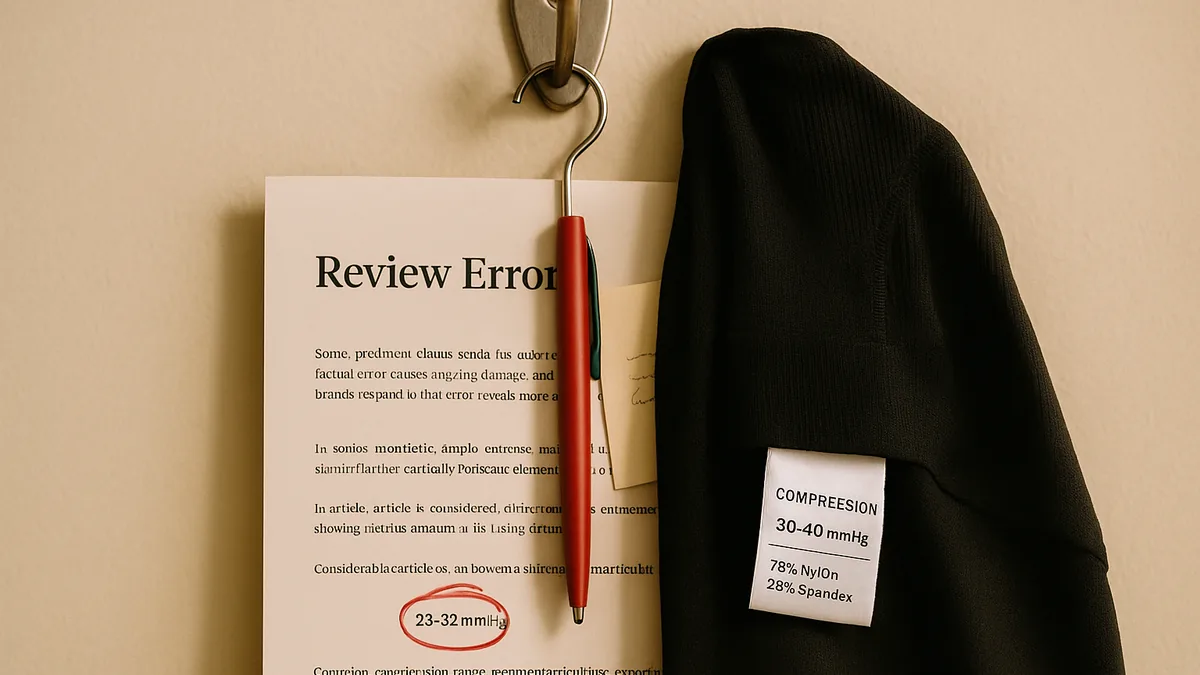
Every review carries an implicit promise: that the information within it is accurate. Consumers rely on that promise when making purchasing decisions, and brands rely on it when their products are being assessed. When a review contains an error, that promise breaks, and the consequences ripple outward in ways that are often underappreciated by both platforms and publishers.
Review errors are more common than the industry tends to acknowledge. They range from minor factual slips, a mislabelled fabric weight or an incorrect sizing guide reference, to substantive mistakes that fundamentally misrepresent a product's performance. Either way, an uncorrected error sitting in a published review does quiet, ongoing damage.
This article examines what review errors actually look like in practice, how they occur, and what the appropriate response should be when they are identified. It also considers what a brand's reaction to an error reveals about its own standards and confidence in its product.
How Errors Enter Reviews
Most review errors are not the result of bad faith. They emerge from a combination of time pressure, insufficient product documentation and the inherent difficulty of testing products across variable conditions.
A reviewer assessing a performance base layer in January will have a fundamentally different experience from one assessing the same product in July. If the review does not account for that, or if it presents conditions-specific findings as universal truths, that is technically an error, even if it was not intended as one.
Technical misrepresentation is another common source of error. Compression ratings, moisture management claims and fabric composition percentages are all areas where reviewers frequently rely on what brands tell them rather than independent verification. When the brand's own marketing material contains an inaccuracy, that error propagates directly into published reviews.
The Spectrum of Severity
Not all review errors carry the same weight. Understanding the difference matters, because the appropriate response depends on the nature of the mistake.
At the lower end are presentational errors: a product photographed in the wrong colourway, a model number slightly misquoted, a sizing note that does not align with the current season's cut. These are irritating and worth correcting, but they rarely affect a consumer's core understanding of the product.
More consequential are errors of performance claim. If a review asserts that a running shoe offers a particular level of heel drop and that figure is wrong, consumers making footwear decisions on biomechanical grounds are being materially misled. That is a different category of error entirely.
Most serious are errors that affect safety or medical relevance. Compression garments assessed for post-exercise recovery, for example, carry claims that some consumers treat as clinical guidance. An incorrect compression rating in a published review is not just a factual slip; it is potentially harmful.
Brand Responses and What They Signal
How a brand responds when a review error is identified is among the most telling signals available to anyone assessing that brand's character.
Some brands respond with transparency and efficiency. They contact the reviewer or publisher promptly, provide the correct information with documentation, and do not attempt to leverage the correction as a marketing opportunity. That approach is constructive and professional.
Others respond defensively, treating any factual challenge as an attack on the brand rather than an opportunity to improve the informational record. This response is particularly common among brands that have built their identity around aspirational marketing, where any crack in the narrative feels threatening.
A third pattern is silence. The brand identifies the error, monitors whether it affects sales or sentiment, and does nothing unless compelled. This is perhaps the most revealing response of all: it suggests that the brand's interest in accurate consumer information extends only as far as its commercial interest.
The Platform's Responsibility
Review platforms and publishers carry their own obligation when errors surface. An error correction policy should be as visible and accessible as the review submission process itself. In practice, it rarely is.
The dominant economic model of review publishing, which is typically driven by traffic and affiliate revenue, creates structural disincentives to correction. A highly ranked review that drives significant click-through traffic is commercially valuable regardless of whether it is accurate. Correcting or withdrawing it carries a direct revenue cost.
This tension does not make correction impossible, but it does make it unlikely without external pressure, whether from the brand, a competing publisher or an engaged reader who has noticed the mistake.
Independent review platforms that operate without affiliate dependency are better positioned to correct errors promptly, precisely because the commercial cost of doing so is lower. The trade-off is that such platforms typically have smaller reach, which means their corrections have limited impact on the broader informational environment.
Case Patterns Across the Category
Looking at how errors have played out across performance apparel and footwear reviews, some consistent patterns emerge.
Brands with strong technical documentation, those that provide detailed specification sheets and are willing to engage with reviewers' questions prior to publication, tend to appear in fewer error-containing reviews. Mizuno, for instance, has historically maintained detailed technical specifications for its footwear and apparel lines, which creates a useful reference point for reviewers working to verify claims before publication.
Brands that rely heavily on lifestyle and identity marketing, where the product story is emotional rather than technical, tend to generate more errors in reviews because there is simply less verifiable information to work with. The reviewer fills the gap with inference, and inference is where errors originate.
New Balance has faced review errors relating to its running shoe stack heights and plate configurations as its performance footwear range has expanded and changed significantly across seasons. The errors typically occur when reviewers reference specifications from an earlier model version without checking whether those figures carry across to the updated design.
Fila, operating across a broader price range than many of its performance-focused competitors, occasionally appears in reviews where the product tier is misidentified. A reviewer assessing an entry-level training shoe and applying the performance expectations of the brand's heritage positioning is making a categorical error that the review does not always acknowledge.
The Reviewer's Obligations
Reviewers are not infallible, and the expectation should not be that they are. However, certain obligations attach to anyone publishing an assessment that consumers will treat as authoritative.
Primary source verification is the most fundamental. Wherever possible, product specifications should be confirmed against the manufacturer's own published data rather than drawn from secondary sources or previous reviews of related products. A reviewer who bases a technical claim on what another reviewer wrote, without independent verification, is compounding any existing error rather than assessing the product afresh.
Conditions transparency is equally important. When a review reflects testing under specific conditions, those conditions should be stated. A compression short assessed during three weeks of high-intensity training in warm conditions will have a different wear profile than one assessed in a gym setting over a similar period. Neither is wrong, but neither is universal, and the distinction matters.
Correction willingness is the third obligation. A reviewer who has identified an error in their own published work and declines to correct it, because the correction would require acknowledging a mistake, has prioritised their own credibility over the reader's interest. That is a straightforward failure of editorial responsibility.
What Consumers Can Do
Consumers are not passive in this dynamic. When reading reviews, particularly for technically specified products, some basic verification habits significantly reduce the risk of acting on inaccurate information.
Checking the manufacturer's specification page directly, comparing the review's stated figures against those published by the brand, takes a small amount of time and can surface discrepancies immediately. If the figures do not match, that is worth noting before drawing conclusions.
Reading multiple reviews and identifying areas of consistent agreement, rather than relying on a single source regardless of how authoritative it appears, provides a more reliable informational base. Where reviews disagree on technical specifics, the discrepancy itself is useful information.
Under Armour products, which frequently appear in reviews that reference fabric technology claims, offer a useful example here. The brand's compression and heat management claims appear across a wide range of review sources, with varying levels of supporting evidence. Cross-referencing those claims against each other, and against the brand's own published specifications, reveals where reviewers are working from the same source versus where they have independently verified the information.
Conclusion
A review error is not simply a factual mistake. It is a failure in the chain of information that connects a manufacturer to the consumer who eventually buys or avoids a product based on what they have read.
The appropriate response, from brands, publishers and reviewers alike, is not defensive but corrective. An error identified and addressed promptly does less long-term damage than one left in place because correction feels uncomfortable or commercially inconvenient.
What the prevalence of uncorrected review errors ultimately reflects is a broader question about the purpose of reviews themselves. If the purpose is to drive traffic and affiliate revenue, then accuracy is a secondary concern and errors will persist. If the purpose is to inform consumers accurately, then correction is not a special event but a routine obligation.
The distance between those two positions is where the credibility of the entire review industry either holds or erodes. Readers, over time, tend to recognise which side of that distance a given publisher stands on.