.png)
Published
Price is the first thing most consumers notice about a product. Construction is what they notice second - usually after something has gone wrong. The gap between these two moments of attention is where a significant amount of purchasing regret originates.
Value is not synonymous with low cost, nor is it simply a matter of premium pricing signalling quality. A product's construction - the materials selected, the methods used to assemble them, and the tolerances applied throughout - determines how well it performs, how long it lasts, and whether it justifies whatever was paid for it. These are measurable, observable qualities, and they deserve far more attention than they typically receive at the point of purchase.
This matters particularly in categories where consumers are buying something they expect to use repeatedly over time. A garment worn twice a week for two years is a fundamentally different value proposition from one that deteriorates after a handful of washes. Understanding how construction influences that equation requires looking at specific attributes rather than relying on brand reputation or marketing language.
What Construction Actually Means
When reviewers refer to construction, they are describing the combination of decisions that determine how a product is physically assembled. In apparel, this includes seam type, stitch density, fabric weight and weave, hem finishing and the quality of any hardware - zips, eyelets, toggle mechanisms. In footwear, it extends to sole bonding methods, midsole density, upper attachment and the durability of any overlays or reinforcement panels.
Each of these elements represents a decision made by the manufacturer, often under cost constraints. Some compromises are invisible at purchase and only emerge under sustained use. Others are apparent to an informed eye before a product is even tried on.
The challenge for consumers is that marketing language rarely engages with construction honestly. Words like "premium", "technical" and "engineered" describe aspiration rather than specification. They indicate a positioning decision, not a manufacturing standard.
Material Choices and Their Consequences
The materials used in a product's construction set a ceiling on its potential quality. No assembly technique can fully compensate for an inherently weak or unsuitable material, though skilled construction can make a mid-range material perform significantly above its base level.
Fabric blends in performance apparel are a useful example. A polyester-spandex blend formulated at the correct ratio for a compression garment will retain its shape and compression properties across hundreds of wash cycles if the knit structure is appropriate. The same blend formulated incorrectly, or knitted at the wrong density, will lose tension and shape within weeks of regular use.
In footwear, midsole foam density is a similar indicator. A midsole that compresses too readily under repeated impact will lose its cushioning properties faster than a denser, better-specified equivalent - even if the two products look identical from the outside and carry similar price tags. Brands like ASICS have historically been transparent about specific foam formulations across their running range, publishing data on cushioning properties that allows meaningful comparison. This kind of technical disclosure is relatively uncommon, and its presence is itself a quality signal.
The Role of Finishing
Finishing is where the gap between adequate and well-made products tends to be most visible. It covers the elements applied after primary assembly - hem stitching, edge binding, label attachment, interior facing and similar details that have little effect on initial appearance but significant effect on long-term durability.
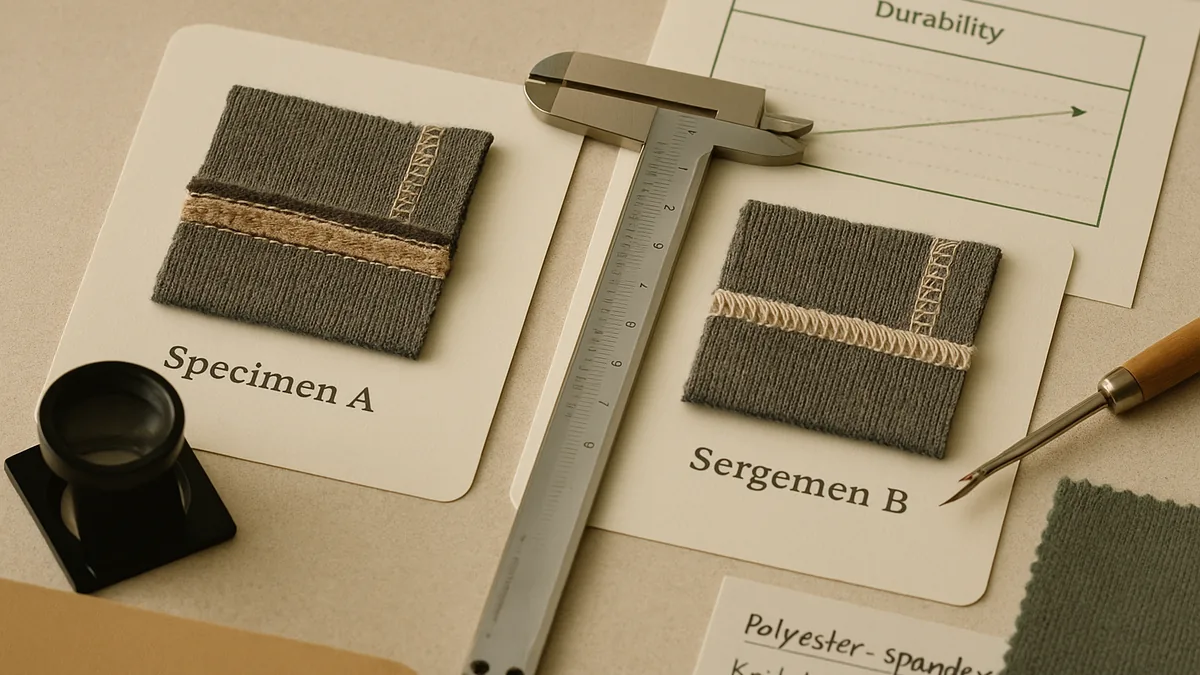
A garment with overstitched seams and bound interior edges will typically outlast one with serged seams and raw interior edges, even if both are constructed from identical fabric. The difference in manufacturing cost is modest. The difference in wear life can be substantial.
Footwear finishing includes the quality of sole edge finishing, the integrity of upper stitching at stress points, and the bonding quality between layers. New Balance, for instance, has built a portion of its market identity around domestically produced lines that emphasise this kind of hand-finished detailing - a commercially explicit signal that finishing quality is considered a differentiating attribute rather than a cost centre.
Assembly Methods and Structural Integrity
How components are joined is as important as what those components are made from. In apparel, flat-lock stitching reduces internal bulk and chafing at seam lines - a meaningful functional benefit in garments worn close to the skin during physical activity. Bonded or welded seams eliminate the seam ridge entirely, improving comfort at the cost of some repairability.
In footwear, sole attachment methods vary considerably in their durability profile. Cemented soles are standard across mid-range footwear but vary in adhesive quality and preparation method. Stitched constructions, where present, generally offer greater long-term adhesion integrity. Brands operating in training and lifestyle categories - Reebok and PUMA among them - use cemented construction broadly across their ranges, though quality varies within each brand's portfolio by price tier and intended use case.
The important point is that construction method needs to match the intended application. A cemented sole that would fail under heavy trail running conditions may be entirely appropriate for a training shoe used primarily on gym floors. Reviewing construction requires assessing fitness for purpose, not applying a universal hierarchy of methods.
Price Tier and Construction Alignment
A persistent source of consumer dissatisfaction is misalignment between price tier and construction standard. This occurs in both directions: some products at modest price points are overbuilt relative to expectations, offering surprisingly strong construction value; others at premium price points rely heavily on brand positioning while delivering construction standards that do not justify the cost differential.
The relationship between price and construction quality is not linear within any category. Across the footwear and apparel market broadly, the strongest correlation between price and construction quality tends to appear in the middle of the market - where manufacturing cost is sufficient to fund genuine material and assembly decisions, but where competitive pressure still requires those decisions to be defensible. At the highest price tiers, margin extraction and brand premium frequently distort the relationship.
This is one reason why independent review methodology focuses on construction attributes that can be assessed directly rather than inferring quality from retail price. Cost per wear, seam integrity after repeated washing, sole adhesion under sustained use - these are observable attributes that price alone does not predict reliably.
Repairability and End-of-Life Considerations
Construction decisions also determine whether a product can be repaired meaningfully. This dimension of value is frequently overlooked at purchase but has become more prominent as consumers in many categories pay greater attention to product longevity and material waste.
A product constructed with accessible seams and standard hardware can often be repaired by a skilled tailor or cobbler at a fraction of replacement cost. Bonded and welded constructions, while offering advantages in initial wear comfort, are often difficult or impossible to repair in any practical sense. Similarly, modern footwear constructions using complex foam-and-rubber compound soles frequently cannot be resoled, limiting the product's functional lifespan to the condition of the original sole unit.
This is not an argument against any particular construction method - each involves genuine trade-offs. It is an argument for transparency about what those trade-offs are, so that buyers can assess the full value profile of a purchase rather than only its performance at the point of sale.
How to Assess Construction Before Purchasing
In practice, most consumers assess construction through a combination of physical inspection and information gathering. Physical inspection at retail remains the most direct method: examining seam quality, checking label and edge finishing, flexing soles and assessing the coherence of layered materials under light pressure. These are quick assessments that yield meaningful signals even without specialist knowledge.
Information gathering involves seeking out reviews that document construction attributes specifically - not impressionistic accounts of comfort or style, but assessments of what changed after sustained use, how materials responded to washing or wear, and where the product showed signs of stress first. This kind of evidence-based review is meaningfully different from first-impression coverage, and worth seeking out explicitly.
Brand-level signals matter but should be used carefully. A brand's reputation for construction quality in one category does not automatically transfer to another. A running shoe brand with strong construction standards in its performance range may apply different standards to its lifestyle or fashion lines. Evaluating construction at the product level rather than the brand level is more reliable.
Conclusion
Construction quality is the primary determinant of whether a product delivers genuine value over time. Price establishes an expectation; construction determines whether that expectation is met.
The attributes that matter most - material specification, assembly method, finishing quality and repairability - are accessible to inspection and analysis. They do not require specialist equipment or deep technical knowledge, only a willingness to look past initial impressions and marketing framing.
For buyers making considered purchases, particularly in categories like performance apparel and footwear where sustained use is the expected pattern, spending time on construction assessment before purchase is one of the more reliable ways to avoid the dissatisfaction that comes from discovering what a product is actually made of only after it has begun to fail.